The kids' book is just days away now. Yesterday I received notification that it had been shipped. It won't be long until I can start watching out the front window for the mail truck.
Harvest the Stars has been good for me. Most importantly, it has motivated me to gather the kids' poems stashed in the various corners of my life and give them some kind of logical platform that allows them to work together. The collection's goal is to take readers on a playful, imaginative romp through the wonders kids find in a typical day.
I can't say enough about the way Billy Jack Boatman enhances the poems with his illustrations, drawn and colored to imitate the pages of a child's coloring book. His style complements the words perfectly, with most of his drawings featuring animals and/or the little boy character on the cover.
Sandy Selby, an accomplished free-lance writer and editor whose work I respect greatly, says, "Noland's clever poetry dares to challenge and expand a child's vocabulary and ignite his or her imagination. There's wisdom within that adults will appreciate, too." Sandy's comments target exactly what I wanted to do: build a collection with appeal for a wide range of readers and listeners.
Again, Harvest the Stars will be available for $10 from me in person or $13 by mail. If you have let me know you want a copy (and I thank you profusely for that!), your name is on my list and I will contact you before long regarding distribution. Please add a comment to this post or send me a personal message if you would like me to add your name to that list.
The book's back cover calls it a "rhythmical, rhyming world where stars are available for the gathering and nothing is impossible." This affirms my belief that anything can happen in a child's imagination--and yours too if you let it.
Showing posts with label children's books. Show all posts
Thursday, September 20, 2018
Thursday, September 13, 2018
Harvest the Stars
When Beenie came to spend the night with me several years ago, he latched onto a plastic dinosaur in my toy box. He played with it all evening, slept with it, and "fed" it Froot Loops for breakfast the next morning. At some point, he named the dinosaur "Darryl."
Darryl ended up going home with Beenie later that day and hasn't been seen around here since. But shortly after that visit, I composed "A Dinosaur Named Darryl," a poem written from the viewpoint of a little boy with a toy tyrannosaurus. At the time, I published it here in "Googie's Attic," and you can read it in my post for March 6, 2015.
But wait. Maybe you would rather read it later this month when it comes out in my new book Harvest the Stars, a collection of fifteen poems for kids. Creatively illustrated by my friend (and pastor) Bill Boatman, this project has been a couple years in the making, but 100 paperback copies should arrive within the next couple weeks. Needless to say, we are excited.
Initially, Harvest the Stars will be available from me in person for $10 a copy or for $3 more by mail. I think it works nicely as a read-aloud book for preschool and the early grades, while older elementary children may like reading it on their own. Measuring 6 x 9 inches, the book makes a good Christmas gift or stocking stuffer.
As I wait for the books to arrive, I will be doing a series of blog and Facebook posts providing more information about the project. And, I have already tried out a proof version on Beenie, as you can see here:
I hope you will watch the blog and social media as this latest writing adventure unfolds. I look forward to sharing more of the backstories explaining how these poems came to be and some of the nice review comments we have received.
Darryl ended up going home with Beenie later that day and hasn't been seen around here since. But shortly after that visit, I composed "A Dinosaur Named Darryl," a poem written from the viewpoint of a little boy with a toy tyrannosaurus. At the time, I published it here in "Googie's Attic," and you can read it in my post for March 6, 2015.
But wait. Maybe you would rather read it later this month when it comes out in my new book Harvest the Stars, a collection of fifteen poems for kids. Creatively illustrated by my friend (and pastor) Bill Boatman, this project has been a couple years in the making, but 100 paperback copies should arrive within the next couple weeks. Needless to say, we are excited.
Initially, Harvest the Stars will be available from me in person for $10 a copy or for $3 more by mail. I think it works nicely as a read-aloud book for preschool and the early grades, while older elementary children may like reading it on their own. Measuring 6 x 9 inches, the book makes a good Christmas gift or stocking stuffer.
As I wait for the books to arrive, I will be doing a series of blog and Facebook posts providing more information about the project. And, I have already tried out a proof version on Beenie, as you can see here:
I hope you will watch the blog and social media as this latest writing adventure unfolds. I look forward to sharing more of the backstories explaining how these poems came to be and some of the nice review comments we have received.
Thursday, January 26, 2017
And the Winners Are . . .
You may recall from my previous blog post that, on Thanksgiving Day just past, twenty-four Christmas storybooks wrapped in festive holiday paper jumped into a red bag and headed home three hours away with four of my grandkids. Their mission was to open and read one together each night from Dec. 1 through Dec. 24, then let me know on Christmas Day which one each of them liked best. It was an Advent alternative to the popular chocolate candy version.
It was a job this distinguished panel of judges did not take lightly.
When the time came to tally the results and name the favorites, the vote ended in a tie. Sooby and Zoomie, pictured above on the ends, both chose Christmas Wonderland by Vilhelm Hansen, while Pooh and Bootsie opted for Santa's Toy Shop.
The way both books focus on Christmas preparations make them ideal reading as the nights count down to the holiday itself. Both have been around to entertain multiple generations of children with their imaginative characters; simple, uplifting story lines; and superb illustrations.
Christmas Wonderland, in particular, is a masterpiece of rich, detailed illustration. Published in 1981 and given to daughter Cookie by her aunt and uncle on the Christmas she was two, this masterpiece by popular Danish illustrator Vilhelm Hansen presents the delightful antics of a group of gnomes as they immerse themselves in all things Christmas.
Besides the artwork--which is, in itself, reason enough to open the book and share it with a child--another particularly engaging aspect of Hansen's book is the way he invites child listeners to answer questions. "Can you count how many birds there are in the tree?" he asks at one point, and "How many names do you know?"
Finally, many humorous situations arise when the gnomes go about their Yuletide business in unorthodox ways. For example, you might imagine how their decision to tune their fiddle using pliers and an oil can affects their Christmas caroling. Or what happens when they share a cup of hot tea with a snowman ("Ice cream would have probably been better."). Then there is the happy mess that occurs when mother gnome falls asleep and lets her rice pudding boil from the stove-top pots onto the kitchen floor.
Santa's Toy Shop, with its illustrations by The Walt Disney Studio, is a Little Golden Book from my own childhood. Published in 1950, it takes us to the North Pole where Santa and his elves are frantic to get all their toys made by their Christmas Eve deadline. Finally, with no time to spare, Santa loads his big bag with all the vintage toys I remember--including train sets, model airplanes, wooden alphabet blocks, checkerboards, and old-fashioned dolls (whose smiles we have seen him detail with a paintbrush).
Santa's one regret is that there is no time, after all this effort, for him to play with any of the toys himself. But the ever-resourceful Mrs. Claus whispers a solution in his ear as he departs from the North Pole: he should stop at the last house on his delivery route to engage in a little playtime along with his milk and cookies.
It was fun to sit here on those December nights and imagine how the kids' bedtime ritual was playing out, and we all agree that the Christmas Book Bag was a fun and worthwhile Advent project. Since I couldn't read the books with them in person, I had no choice but to revert to the less original version of the countdown, the one involving a piece of chocolate candy every night.
I tried not to let it bother me, though. A Googie has to do what a Googie has to do.
.
It was a job this distinguished panel of judges did not take lightly.
When the time came to tally the results and name the favorites, the vote ended in a tie. Sooby and Zoomie, pictured above on the ends, both chose Christmas Wonderland by Vilhelm Hansen, while Pooh and Bootsie opted for Santa's Toy Shop.
The way both books focus on Christmas preparations make them ideal reading as the nights count down to the holiday itself. Both have been around to entertain multiple generations of children with their imaginative characters; simple, uplifting story lines; and superb illustrations.
Christmas Wonderland, in particular, is a masterpiece of rich, detailed illustration. Published in 1981 and given to daughter Cookie by her aunt and uncle on the Christmas she was two, this masterpiece by popular Danish illustrator Vilhelm Hansen presents the delightful antics of a group of gnomes as they immerse themselves in all things Christmas.
Besides the artwork--which is, in itself, reason enough to open the book and share it with a child--another particularly engaging aspect of Hansen's book is the way he invites child listeners to answer questions. "Can you count how many birds there are in the tree?" he asks at one point, and "How many names do you know?"
Finally, many humorous situations arise when the gnomes go about their Yuletide business in unorthodox ways. For example, you might imagine how their decision to tune their fiddle using pliers and an oil can affects their Christmas caroling. Or what happens when they share a cup of hot tea with a snowman ("Ice cream would have probably been better."). Then there is the happy mess that occurs when mother gnome falls asleep and lets her rice pudding boil from the stove-top pots onto the kitchen floor.
Santa's Toy Shop, with its illustrations by The Walt Disney Studio, is a Little Golden Book from my own childhood. Published in 1950, it takes us to the North Pole where Santa and his elves are frantic to get all their toys made by their Christmas Eve deadline. Finally, with no time to spare, Santa loads his big bag with all the vintage toys I remember--including train sets, model airplanes, wooden alphabet blocks, checkerboards, and old-fashioned dolls (whose smiles we have seen him detail with a paintbrush).
Santa's one regret is that there is no time, after all this effort, for him to play with any of the toys himself. But the ever-resourceful Mrs. Claus whispers a solution in his ear as he departs from the North Pole: he should stop at the last house on his delivery route to engage in a little playtime along with his milk and cookies.
It was fun to sit here on those December nights and imagine how the kids' bedtime ritual was playing out, and we all agree that the Christmas Book Bag was a fun and worthwhile Advent project. Since I couldn't read the books with them in person, I had no choice but to revert to the less original version of the countdown, the one involving a piece of chocolate candy every night.
I tried not to let it bother me, though. A Googie has to do what a Googie has to do.
.
Sunday, January 15, 2017
Advent Without Chocolate
If you are a kid, the word "advent," apart from its religious context, usually suggests "calendar," and that in turn brings to mind one thing: candy.
In Christmas seasons past, I have given the grandkids those grocery store advent calendars with twenty-four little doors, each hiding a piece of foil-wrapped chocolate. These enable the kids to "count down" to Christmas by opening a door and indulging in a bite of chocolate every day from Dec. 1 through Christmas Eve.
This year, however, I decided to adapt an idea I stumbled onto on Facebook: buy children's Christmas books, wrap them individually, and let kids unwrap one each day in December until Christmas. That suggestion was enough to start the wheels turning in this old Googie-brain.
I have bookcases full of books to read with the kids when they are at Googie's house. Some are leftovers from my own children, and others I have picked up at clearance events and garage sales. But I have noticed that the Christmas books are hardly ever read. December is usually so busy with Christmas parties, programs, and other events that the kids rarely visit then--and who wants to read a Christmas book in spring, summer, or fall?
Dear Kids:
Here is a fun way to count down the days until our Christmas together. As you know, I have lots of books at my house, but it seems like we don't often get to read the Christmas ones together. So . . .
Here are the rules:
Love, Googie
Post-Christmas feedback indicates that the Christmas Book Bag went over well. I hope to follow this blog post with a review of the books the kids liked most. As for my own favorite, I saved Charles M. Schulz's A Charlie Brown Christmas for Christmas Day itself.

This Hallmark Gift Book, published in 2010, follows Charlie Brown's angst-ridden search for both a suitable tree and the meaning of Christmas itself. Its interactive sound bytes enable us to hear Linus reciting the Biblical Christmas story from Luke 2 and the whole Peanuts gang singing "Hark, the Herald Angels Sing."
True to form, however, Christmas Day came and went in a flurry, and I had to set it aside for another time. That's what often happens to Christmas books--and all the more reason to consider your own version of the Christmas Book Bag for the children you love.
Watch out, Beenie and Heero. There is a big red bag full of books headed your way in a little over ten months.
Afternote: Displaying A Charlie Brown Christmas above is Chi-Chi, a lovable primate who was inadvertently left at Googie's Thanksgiving weekend. You will be glad to know he was reunited with Pooh as a joke "present" on Christmas Day.
In Christmas seasons past, I have given the grandkids those grocery store advent calendars with twenty-four little doors, each hiding a piece of foil-wrapped chocolate. These enable the kids to "count down" to Christmas by opening a door and indulging in a bite of chocolate every day from Dec. 1 through Christmas Eve.
This year, however, I decided to adapt an idea I stumbled onto on Facebook: buy children's Christmas books, wrap them individually, and let kids unwrap one each day in December until Christmas. That suggestion was enough to start the wheels turning in this old Googie-brain.
I have bookcases full of books to read with the kids when they are at Googie's house. Some are leftovers from my own children, and others I have picked up at clearance events and garage sales. But I have noticed that the Christmas books are hardly ever read. December is usually so busy with Christmas parties, programs, and other events that the kids rarely visit then--and who wants to read a Christmas book in spring, summer, or fall?
On a mission, I scoured the kids' bookcases. Was it possible I could find as many as twenty-four Christmas books? It didn't take long to see that I actually had a few more than that, so I grabbed a bright red bag, dubbed it the "Christmas Book Bag," and lost myself in a whirlwind of paper, scissors, and tape. I would try this "Advent-ure" first with daughter Cookie's four kids. Here are the directions I attached to the bag, which I sent home with them Thanksgiving weekend.
Dear Kids:
Here is a fun way to count down the days until our Christmas together. As you know, I have lots of books at my house, but it seems like we don't often get to read the Christmas ones together. So . . .
Here are the rules:
- Inside this bag are 24 of my Christmas stories, individually wrapped. Take turns choosing and unwrapping one book each night. Zoomie starts on Dec. 1, then Bootsie, then Pooh, then Sooby--and so on until you read your last book on Christmas Eve.
- Anyone who can may do the reading aloud to all of you--but you must enjoy each night's story together after you have brushed your teeth and are ready for bed.
- Bring the bag of books back on Christmas Day so I can do this project with your cousins next year. That day, I will ask each of you to tell me what your favorite story was.
Love, Googie
Post-Christmas feedback indicates that the Christmas Book Bag went over well. I hope to follow this blog post with a review of the books the kids liked most. As for my own favorite, I saved Charles M. Schulz's A Charlie Brown Christmas for Christmas Day itself.
This Hallmark Gift Book, published in 2010, follows Charlie Brown's angst-ridden search for both a suitable tree and the meaning of Christmas itself. Its interactive sound bytes enable us to hear Linus reciting the Biblical Christmas story from Luke 2 and the whole Peanuts gang singing "Hark, the Herald Angels Sing."
True to form, however, Christmas Day came and went in a flurry, and I had to set it aside for another time. That's what often happens to Christmas books--and all the more reason to consider your own version of the Christmas Book Bag for the children you love.
Watch out, Beenie and Heero. There is a big red bag full of books headed your way in a little over ten months.
Afternote: Displaying A Charlie Brown Christmas above is Chi-Chi, a lovable primate who was inadvertently left at Googie's Thanksgiving weekend. You will be glad to know he was reunited with Pooh as a joke "present" on Christmas Day.
Monday, August 17, 2015
It All Makes Sense
"Three-year-olds learn primarily through exploring, using all the senses." So says the "Child Development Tracker, "a feature on the PBSparents web page. I may have already suspected that, but I know it for sure after spending twenty-five straight, mostly one-on-one, hours with Beenie the last couple days. With Pa-pa working basically sun-up to sundown at our state fair this week, Beenie was just what I needed to add some fun and excitement to these long days at home by myself.
Just look at that face. Doesn't it just cry out with enthusiasm for exploring? Indeed, the two of us had a glorious time together, with no sense left undeveloped (and some of them working overtime). Here is a rundown of our adventures for the perusal of all you child development specialists:
Certainly we deserve high marks in the tactile category. Those ten little Lego people (most of them wearing helmets--go figure) sitting side by side on the block bench we created took some serious hand-eye coordination, small motor skills, and downright manual dexterity. Add to this a couple hours in the pool both days, and you have a field day for your sensory receptors.
Accompanying us to the pool were three plastic dinosaurs--twin brontosauruses Tex and Rex (who is surprised?) and Max, who, just to complicate things, is a T-Rex. The dinosaurs were quite happy to bob around for our entertainment, until, due to minuscule, invisible holes in their anatomy, they took on water and sank. This required a deep-sea fishing expedition, after which considerable squeezing was required to rid them of excess water, leading naturally to a spirited discussion, complete with demonstration, of the potty habits of prehistoric creatures.
In our drier moments, Beenie and I moved on to develop the senses of taste and smell, which took the form of a huge bowl of popcorn the first day and a box of donuts (with chocolate icing) the next morning. To accompany our popcorn ("Can you get your own bowl, Googie?"), Beenie picked a movie from my sizable collection and we settled with our blankets into a huge recliner big enough for the two of us to sit side by side.
I would not have expected the movie he picked--Baby Mozart--but it offered us thirty minutes of utter nostalgia and serenity with its parade of colorful baby toys against the backdrop of lively, upbeat Mozart music. A VHS videotape we played together every afternoon Beenie stayed with me during his first year, it has not lost its appeal for him despite its intent to target younger children. Given his choice, Beenie asked for "Baby Ein-a-stein," and in that we got our fill of visual and auditory delight--supplemented, of course, by the books we snuggled up together to read at naptime.
Beenie's favorite of my storybooks, at the moment, are Margaret Wise Brown's Goodnight Moon (which he calls "Fireplace" because of the cover picture), Jane Miller's Farm Alphabet Book, Roger Priddy's Happy Baby Colors, and Mary Murphy's I Like It When . . . ." His CD of choice for car travel is Barney's House, and with that, we are back to where we started with Barney's close relatives Rex, Tex, and Max the T-Rex.
So, yeah, PBS people, the three-year-old-year is truly sensory in nature for both little boys and their Googies. He might be exploring for the purpose of learning, but I just get to revel in the sensory delights that are mine alone. I get to enjoy the warm snuggles, that cute little voice--and that rare moment when I actually get to have a bite of my own popcorn.
Just look at that face. Doesn't it just cry out with enthusiasm for exploring? Indeed, the two of us had a glorious time together, with no sense left undeveloped (and some of them working overtime). Here is a rundown of our adventures for the perusal of all you child development specialists:
Certainly we deserve high marks in the tactile category. Those ten little Lego people (most of them wearing helmets--go figure) sitting side by side on the block bench we created took some serious hand-eye coordination, small motor skills, and downright manual dexterity. Add to this a couple hours in the pool both days, and you have a field day for your sensory receptors.
Accompanying us to the pool were three plastic dinosaurs--twin brontosauruses Tex and Rex (who is surprised?) and Max, who, just to complicate things, is a T-Rex. The dinosaurs were quite happy to bob around for our entertainment, until, due to minuscule, invisible holes in their anatomy, they took on water and sank. This required a deep-sea fishing expedition, after which considerable squeezing was required to rid them of excess water, leading naturally to a spirited discussion, complete with demonstration, of the potty habits of prehistoric creatures.
In our drier moments, Beenie and I moved on to develop the senses of taste and smell, which took the form of a huge bowl of popcorn the first day and a box of donuts (with chocolate icing) the next morning. To accompany our popcorn ("Can you get your own bowl, Googie?"), Beenie picked a movie from my sizable collection and we settled with our blankets into a huge recliner big enough for the two of us to sit side by side.
I would not have expected the movie he picked--Baby Mozart--but it offered us thirty minutes of utter nostalgia and serenity with its parade of colorful baby toys against the backdrop of lively, upbeat Mozart music. A VHS videotape we played together every afternoon Beenie stayed with me during his first year, it has not lost its appeal for him despite its intent to target younger children. Given his choice, Beenie asked for "Baby Ein-a-stein," and in that we got our fill of visual and auditory delight--supplemented, of course, by the books we snuggled up together to read at naptime.
Beenie's favorite of my storybooks, at the moment, are Margaret Wise Brown's Goodnight Moon (which he calls "Fireplace" because of the cover picture), Jane Miller's Farm Alphabet Book, Roger Priddy's Happy Baby Colors, and Mary Murphy's I Like It When . . . ." His CD of choice for car travel is Barney's House, and with that, we are back to where we started with Barney's close relatives Rex, Tex, and Max the T-Rex.
So, yeah, PBS people, the three-year-old-year is truly sensory in nature for both little boys and their Googies. He might be exploring for the purpose of learning, but I just get to revel in the sensory delights that are mine alone. I get to enjoy the warm snuggles, that cute little voice--and that rare moment when I actually get to have a bite of my own popcorn.
Saturday, July 18, 2015
Here's to Dr. Seuss!
It's official--Dr. Seuss is immortal.
Although he died in 1991 at age 87, his heretofore unpublished book is being released this month, according to the current issue of American Profile (July 19-25, 2015, p. 6).
Yes, right there on America's bookshelves, alongside fellow Pulitzer Prize winner Harper Lee's much-anticipated Go Set a Watchman, will be Theodor Seuss Geisel's What Pet Should I Get? I can't decide which one I am the most anxious to get my hands on.
While Lee's To Kill a Mockingbird has been, up to now, the sole ticket to her widespread literary fame, Dr. Seuss's prolific collection of children's books has nurtured the imaginations of generations of children for nearly a century. Among them, I am proud to say, have been my little brother, my own children, and my grandkids.
On the occasion of his new book release nearly twenty-five years after his death, I offer him this poetic tribute, composed in the tradition of his own readily recognizable rhyme and metrical patterns. The poem is an acrostic, meaning that the first letters of each line, when read downward, spell out his name. I hope it will bring some great memories to mind as you anticipate with me the release of What Pet Should I Get?
Although he died in 1991 at age 87, his heretofore unpublished book is being released this month, according to the current issue of American Profile (July 19-25, 2015, p. 6).
Yes, right there on America's bookshelves, alongside fellow Pulitzer Prize winner Harper Lee's much-anticipated Go Set a Watchman, will be Theodor Seuss Geisel's What Pet Should I Get? I can't decide which one I am the most anxious to get my hands on.
While Lee's To Kill a Mockingbird has been, up to now, the sole ticket to her widespread literary fame, Dr. Seuss's prolific collection of children's books has nurtured the imaginations of generations of children for nearly a century. Among them, I am proud to say, have been my little brother, my own children, and my grandkids.
On the occasion of his new book release nearly twenty-five years after his death, I offer him this poetic tribute, composed in the tradition of his own readily recognizable rhyme and metrical patterns. The poem is an acrostic, meaning that the first letters of each line, when read downward, spell out his name. I hope it will bring some great memories to mind as you anticipate with me the release of What Pet Should I Get?
A Salute to Dr. Seuss
The Cat in the Hat came when Mother was out.
He made our fish nervous and then made him shout.
Each Who down in Whoville remembers the day
Old Grinch came and kidnapped their Christmas away.
Do you like green eggs? Will you eat some green ham?
Oh, come on and try them--be like Sam I Am!
Remember The Foot Book and all of those feet
So distinctly unique as they walked down the street?
Elephants don't often roost in a tree
Unless Horton sits down where a bird ought to be.
Such genius poured from this pen and--oh boy--
Such a legacy left for us all to enjoy!
Geisel was great with the rhythm and rhyme.
Ev'ry kid with a book of his had a great time
Imagining characters, playing with sound
So ingrained in the words that this poet wrote down.
Each fun-loving reader, regardless of age,
Loves the way Doc could play with the words on a page.
Friday, March 20, 2015
Blueberry Beenie
Beenie wouldn't have it any other way: he was determined that he and I were going to make a blueberry pie together.
This idea made its way into his cute little head by way of a bedtime story titled Grandma, Grandpa, and Me by Mercer Mayer. In the story, a rodent-like character named Little Critter is dropped off at his grandparents' house for a sleepover.
One highlight of his stay is helping his grandma make a blueberry pie for the country fair. The book's cover shows Little Critter rolling out pie dough with a big bowl of freshly picked blueberries nearby.
Unlike the super-grandma in the story, I will admit to using pie crusts from the dairy case of our friendly neighborhood grocer and canned blueberry pie filling. There just aren't many blueberries ready for picking in Missouri in March, and I wasn't sure Beenie's attention span would hold through the old-fashioned dough-rolling process. (Besides, we had some serious playing to get done that night.)
But just like in the story, we filled a crust with a juicy blueberry filling and sealed it up tight. Just before that, Beenie reminded me to add the same secret ingredient Little Critter's grandma used--so we threw in a little love.
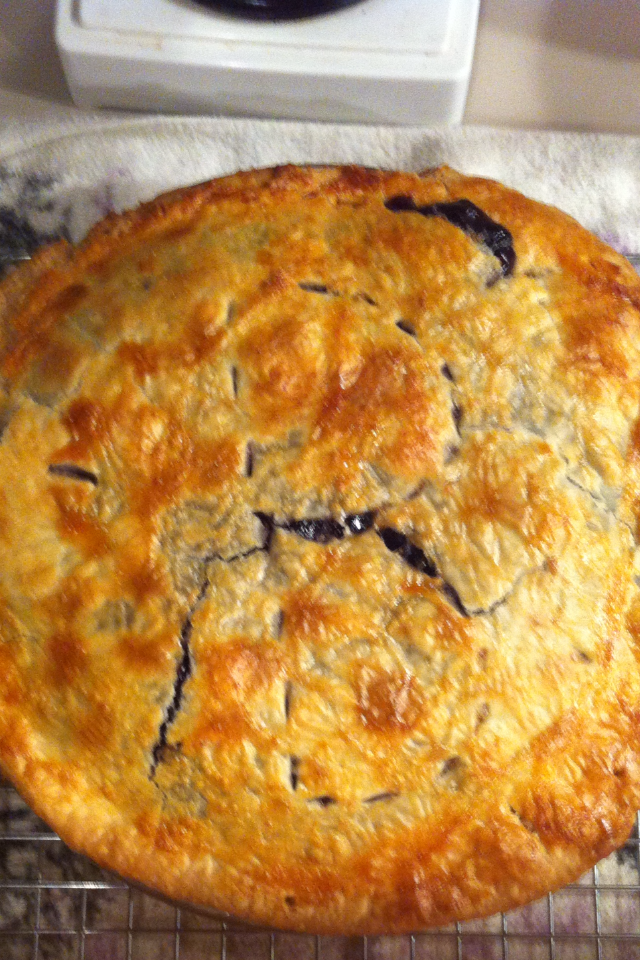
Then we marked it with a "B" for "Beenie" (and "blueberry") and put it in the oven to bake When it came out piping hot, this is what we had:
This idea made its way into his cute little head by way of a bedtime story titled Grandma, Grandpa, and Me by Mercer Mayer. In the story, a rodent-like character named Little Critter is dropped off at his grandparents' house for a sleepover.
One highlight of his stay is helping his grandma make a blueberry pie for the country fair. The book's cover shows Little Critter rolling out pie dough with a big bowl of freshly picked blueberries nearby.
Unlike the super-grandma in the story, I will admit to using pie crusts from the dairy case of our friendly neighborhood grocer and canned blueberry pie filling. There just aren't many blueberries ready for picking in Missouri in March, and I wasn't sure Beenie's attention span would hold through the old-fashioned dough-rolling process. (Besides, we had some serious playing to get done that night.)
But just like in the story, we filled a crust with a juicy blueberry filling and sealed it up tight. Just before that, Beenie reminded me to add the same secret ingredient Little Critter's grandma used--so we threw in a little love.
Then we marked it with a "B" for "Beenie" (and "blueberry") and put it in the oven to bake When it came out piping hot, this is what we had:
But not for long, because here is what happened soon after that:
With a little scoop of ice cream on top, our blueberry pie was a winner just like Little Critter's. Later that night, Beenie crawled in bed between Pa-pa and me for a good night's sleep--another idea he got from Little Critter.
Today, on Pa-pa's and my thirty-fourth wedding anniversary, our little blueberry pie boy turns three years old. So even though our pie is long gone, we will soon be diving into a chocolate cake with blue icing and dinosaur candles.
Somehow, I think Little Critter and his grandma would approve of that.
Saturday, February 21, 2015
If You Give a Kid a Computer
"If you give a student a pancake . . . " is a front-page headline in yesterday's edition of my small hometown newspaper. It marks a photo feature in which a local kindergarten teacher serves her students pancakes following a reading activity featuring several well-loved children's stories written by Laura Numeroff.
Numeroff is the author of If You Give a Pig a Pancake and several other popular "circular" tales involving various animals, sweet things, and, usually, an alliterative title. These stories follow the "If . . . then" format throughout until they reach a conclusion that ends just as the story began, in this case with a pig and a pancake.
Besides the one about the pig published in 1998, Numeroff's successful series, which began in 1985 with If You Give a Mouse a Cookie, includes If You Give a Moose a Muffin (1991), If You Give a Cat a Cupcake (2008), If You Give a Dog a Donut (2011), and, most recently, If You Give a Bear a Brownie (2014).
Yesterday's headline caught my attention partly because I am always interested in activities that promote children's literacy but mostly because it sounded familiar. Granddaughter Sooby, a second-grader, is obviously familiar with these stories, as she composed her own variation last time she came to Googie's. During that visit, she sat at my computer and composed her own mixed-and-matched spin-off of Numeroff's idea, titled If You Give a Cow a Cupcake. She worked on it off and on for several hours.
Sooby's story follows. I have corrected only spacing. All the spelling and punctuation are as she originally typed the piece, something I think is pretty remarkable for a seven-year-old--but I am prejudiced, of course. Here is Sooby's story:
If you give a cow a cupcake, she'll want some icing. When you give her the icing, she'll turn a very, very, dark pink. That will remind her of the time that her cousin kissed her, [and after that, she blushed.] so she'll want a kiss from you. Aaaaaaahhhhhhhh! She'll chase you all over the house! When she reaches your bedroom, she'll sneak under the bed.
When you [try to] lie down and take a rest, she'll jump out at you and get her target. Then you'll blush. You'll get out your sewing kit to calm yourself down. You've been sewing a fancy shirt for your older brother who is getting married next week. The shirt will have buttons, a lace collar, a pocket on the upper left, and glass buttons on the edge of each sleeve.
She'll see your needle running in and out, and that will remind her of her other jumping cousin, who she loved to copy. She'll copy your needle by bouncing up and down. You'll see her doing it and get bored, and finally you'll get so bored that you'll have to put your sewing kit away. When she sees that you've put it away, she'll stop in mid-air, and land in your ash basket.
Of course, she'll be all covered in soot, so she'll want to take a bath. When you turn on the hot water, she'll turn a very, very dark pink. Turning pink will remind her of your icing. And chances are, if she asks you for icing, she's going to want a cupcake to go with it.
We won't pause here to ponder the elaborate design of my brother's wedding shirt (love that lace collar) or my tendency to get out my sewing kit when both overly excited and bored. We won't discuss the logistics of having a pink cow in my bathtub, or, even worse, one chasing after me for a kiss or lying in wait for me under my bed.
Instead, we'll just commend Laura Numeroff for her ability to spark imagination and the love for reading in generations of children and the kindergarten teacher in my hometown for using Numeroff's stories as a springboard for her own creative literacy project. Ladies, we simply cannot have enough people like you around to make sure our kids grow to respect and love the written word.
And, of course, I'll offer a few special kudos to Sooby for this writing--which I plan to share with her boyfriend when she's in college--and for once again showing her Googie the miracles that can happen--if you give a kid a computer.
Numeroff is the author of If You Give a Pig a Pancake and several other popular "circular" tales involving various animals, sweet things, and, usually, an alliterative title. These stories follow the "If . . . then" format throughout until they reach a conclusion that ends just as the story began, in this case with a pig and a pancake.
Besides the one about the pig published in 1998, Numeroff's successful series, which began in 1985 with If You Give a Mouse a Cookie, includes If You Give a Moose a Muffin (1991), If You Give a Cat a Cupcake (2008), If You Give a Dog a Donut (2011), and, most recently, If You Give a Bear a Brownie (2014).
Yesterday's headline caught my attention partly because I am always interested in activities that promote children's literacy but mostly because it sounded familiar. Granddaughter Sooby, a second-grader, is obviously familiar with these stories, as she composed her own variation last time she came to Googie's. During that visit, she sat at my computer and composed her own mixed-and-matched spin-off of Numeroff's idea, titled If You Give a Cow a Cupcake. She worked on it off and on for several hours.
Sooby's story follows. I have corrected only spacing. All the spelling and punctuation are as she originally typed the piece, something I think is pretty remarkable for a seven-year-old--but I am prejudiced, of course. Here is Sooby's story:
If You Give a Cow a Cupcake
If you give a cow a cupcake, she'll want some icing. When you give her the icing, she'll turn a very, very, dark pink. That will remind her of the time that her cousin kissed her, [and after that, she blushed.] so she'll want a kiss from you. Aaaaaaahhhhhhhh! She'll chase you all over the house! When she reaches your bedroom, she'll sneak under the bed.
When you [try to] lie down and take a rest, she'll jump out at you and get her target. Then you'll blush. You'll get out your sewing kit to calm yourself down. You've been sewing a fancy shirt for your older brother who is getting married next week. The shirt will have buttons, a lace collar, a pocket on the upper left, and glass buttons on the edge of each sleeve.
She'll see your needle running in and out, and that will remind her of her other jumping cousin, who she loved to copy. She'll copy your needle by bouncing up and down. You'll see her doing it and get bored, and finally you'll get so bored that you'll have to put your sewing kit away. When she sees that you've put it away, she'll stop in mid-air, and land in your ash basket.
Of course, she'll be all covered in soot, so she'll want to take a bath. When you turn on the hot water, she'll turn a very, very dark pink. Turning pink will remind her of your icing. And chances are, if she asks you for icing, she's going to want a cupcake to go with it.
The End
We won't pause here to ponder the elaborate design of my brother's wedding shirt (love that lace collar) or my tendency to get out my sewing kit when both overly excited and bored. We won't discuss the logistics of having a pink cow in my bathtub, or, even worse, one chasing after me for a kiss or lying in wait for me under my bed.
Instead, we'll just commend Laura Numeroff for her ability to spark imagination and the love for reading in generations of children and the kindergarten teacher in my hometown for using Numeroff's stories as a springboard for her own creative literacy project. Ladies, we simply cannot have enough people like you around to make sure our kids grow to respect and love the written word.
And, of course, I'll offer a few special kudos to Sooby for this writing--which I plan to share with her boyfriend when she's in college--and for once again showing her Googie the miracles that can happen--if you give a kid a computer.
Sunday, April 13, 2014
Pooh's Bedtime Lesson
Night before last, Pooh chose My Visit to the Dinosaurs by Aliki for his bedtime story. Unlike the usual bedtime fare of fairy tales and talking animals, Aliki's little science book lured Googie in with the potential for some serious discussion in the areas of archaeology and paleontology. I could hardly wait for Pooh to finish brushing his teeth so that we could make our way toward bedtime by way of the Prehistoric Era.
Pages 1 through 8 were pretty predictable. We joined a typical storybook family on a trip to the museum where the dinosaur skeletons ruled. We marveled at the long apatosaurus, preserved in sand and mud until the first dinosaur fossil was unearthed nearly 200 years ago.
Then came p. 9 with its illustration of a nest of fossil dinosaur eggs, and that's when the discussion got really interesting.
"Those eggs won't hatch," Pooh tells me with authority. Sniffing out a teachable moment, I prepare to pounce. Getting a whiff of the chance to discuss the stone-like condition of fossils, I prepare to lecture the boy on the nature of archaeological finds.
"No, they won't hatch," I said. "Do you know why?" I was sure he did not. I was anticipating some lesson I could teach him about, say, sedimentary rocks. Maybe we would even discuss the long-ago processes of carbonization and petrifaction.
"Yes," Pooh said, surprising me. "The eggs won't hatch because the daddy hasn't done anything special to them."
Say what? The daddy? Does something? Special? To the eggs?
I pulled my head out of academia and my eyes back to p. 9 and the nest of eggs. Sure enough, there was no sign of a daddy anywhere in the vicinity. I had to give in on this one.
On the eve of a long day celebrating family birthdays and an early Easter, I was not interested in inquiring further about the special contributions made millions of years ago by dinosaur daddies--or, for that matter, by any daddies anytime. I am quite content to let Pooh's parents explore the concept of special with him at whatever time they--or he--chooses. This time around, I am just the storybook reader.
So I would have to say that, night before last, I am the one who got the bedtime lesson: Fairy tales and stories about talking animals are much safer, at least for now. As I learned, dinosaur eggs can lead you into fields you might not be quite ready to excavate.
Pages 1 through 8 were pretty predictable. We joined a typical storybook family on a trip to the museum where the dinosaur skeletons ruled. We marveled at the long apatosaurus, preserved in sand and mud until the first dinosaur fossil was unearthed nearly 200 years ago.
Then came p. 9 with its illustration of a nest of fossil dinosaur eggs, and that's when the discussion got really interesting.
"No, they won't hatch," I said. "Do you know why?" I was sure he did not. I was anticipating some lesson I could teach him about, say, sedimentary rocks. Maybe we would even discuss the long-ago processes of carbonization and petrifaction.
"Yes," Pooh said, surprising me. "The eggs won't hatch because the daddy hasn't done anything special to them."
Say what? The daddy? Does something? Special? To the eggs?
I pulled my head out of academia and my eyes back to p. 9 and the nest of eggs. Sure enough, there was no sign of a daddy anywhere in the vicinity. I had to give in on this one.
On the eve of a long day celebrating family birthdays and an early Easter, I was not interested in inquiring further about the special contributions made millions of years ago by dinosaur daddies--or, for that matter, by any daddies anytime. I am quite content to let Pooh's parents explore the concept of special with him at whatever time they--or he--chooses. This time around, I am just the storybook reader.
So I would have to say that, night before last, I am the one who got the bedtime lesson: Fairy tales and stories about talking animals are much safer, at least for now. As I learned, dinosaur eggs can lead you into fields you might not be quite ready to excavate.
Saturday, January 11, 2014
The Book Lady Goes "Mad"
If you read my previous blog post, you know that a wonderful little story titled The Bugliest Bug had my grandkids all (brace yourself) abuzz with excitement the last time the Book Lady (Googie in disguise) surprised them at their front door with a bag full of library books.
You may also recall that I promised to elaborate on a second crowd pleaser in my next writing, so without any further ado let me introduce you to Addie Adams' Hilda and the Mad Scientist. While the bug book wins the prize for bringing science to life for all three kids, it was Hilda who grabbed the imaginations of the two older ones with a most delightful result (which I will tell you about later).
Hilda is an eccentric middle-aged, middle-European woman who, if she weren't so darned lovable, might be mistaken for a busybody. Repeatedly, she imposes herself on her fellow villagers in her own sincere but misguided attempts to be helpful.
Unfortunately, in the course of her undertakings, much like the beloved Amelia Bedelia, she often evokes more damage than improvement in whatever situation she forces herself into. Truthfully, at the end of Hilda's extended "help" sessions, people are much more glad to see her go than they were to see her come.
This is definitely the case with Dr. Weinerstein, the mad scientist who lives in a spooky old house atop a hill just outside the village. As his name suggests, Dr. Weinerstein is in the business of manufacturing monsters in a laboratory well-stocked with potions and poisons.
But when Hilda learns that Dr. Weinerstein suffers from rheumatism, off she goes to cook, clean, and care for him. "I go where I'm needed," she repeats as her mantra, "and stay until I'm not." Needless to say, Dr. Weinerstein wants to get rid of her as quickly as possible, so he sets out to create a monster that he thinks is sure to scare her away.
I won't spoil the O.Henry ending for you here, but suffice it to say that, because Hilda takes it upon herself to purge the good doctor's arsenal of bad stuff and replace it with something more wholesome and healthy, the monster turns out to be quite different from what Dr. Weinerstein--and the unsuspecting reader--envision. As a result, Hilda is delighted, and so are we.
In addition to the unexpected plot twist and the perfectly rendered illustrations by Lisa Thiesing, Hilda and the Mad Scientist gives young readers and listeners unforgettable characters and fresh, imaginative dialogue. For this reason, I spent much of the afternoon as a drama coach of sorts, prompting Sooby and Pooh as they acted out the story complete with makeshift costumes and props.
In the role of Hilda, Sooby remembered most of the lines, or facsimiles thereof, without much prompting. She was hilarious as she swept and clattered about the "kitchen," delighted at the prospect of bossing the cranky old doctor around. Pooh gave the role of Dr. Weinerstein his all, insisting that Hilda "leave right now" and rubbing his hands together in his best diabolical fashion as he set about his monster-making.
All in all, it was a great day last time the Book Lady went to Kansas. It was a day filled with bugs and monsters and laughter and the magic of the written word. It was an opportunity to live for a while in a world where the good guys come out on top and the bad guys get their just deserts.
You may also recall that I promised to elaborate on a second crowd pleaser in my next writing, so without any further ado let me introduce you to Addie Adams' Hilda and the Mad Scientist. While the bug book wins the prize for bringing science to life for all three kids, it was Hilda who grabbed the imaginations of the two older ones with a most delightful result (which I will tell you about later).
Hilda is an eccentric middle-aged, middle-European woman who, if she weren't so darned lovable, might be mistaken for a busybody. Repeatedly, she imposes herself on her fellow villagers in her own sincere but misguided attempts to be helpful.
Unfortunately, in the course of her undertakings, much like the beloved Amelia Bedelia, she often evokes more damage than improvement in whatever situation she forces herself into. Truthfully, at the end of Hilda's extended "help" sessions, people are much more glad to see her go than they were to see her come.
This is definitely the case with Dr. Weinerstein, the mad scientist who lives in a spooky old house atop a hill just outside the village. As his name suggests, Dr. Weinerstein is in the business of manufacturing monsters in a laboratory well-stocked with potions and poisons.
But when Hilda learns that Dr. Weinerstein suffers from rheumatism, off she goes to cook, clean, and care for him. "I go where I'm needed," she repeats as her mantra, "and stay until I'm not." Needless to say, Dr. Weinerstein wants to get rid of her as quickly as possible, so he sets out to create a monster that he thinks is sure to scare her away.
I won't spoil the O.Henry ending for you here, but suffice it to say that, because Hilda takes it upon herself to purge the good doctor's arsenal of bad stuff and replace it with something more wholesome and healthy, the monster turns out to be quite different from what Dr. Weinerstein--and the unsuspecting reader--envision. As a result, Hilda is delighted, and so are we.
In addition to the unexpected plot twist and the perfectly rendered illustrations by Lisa Thiesing, Hilda and the Mad Scientist gives young readers and listeners unforgettable characters and fresh, imaginative dialogue. For this reason, I spent much of the afternoon as a drama coach of sorts, prompting Sooby and Pooh as they acted out the story complete with makeshift costumes and props.
In the role of Hilda, Sooby remembered most of the lines, or facsimiles thereof, without much prompting. She was hilarious as she swept and clattered about the "kitchen," delighted at the prospect of bossing the cranky old doctor around. Pooh gave the role of Dr. Weinerstein his all, insisting that Hilda "leave right now" and rubbing his hands together in his best diabolical fashion as he set about his monster-making.
All in all, it was a great day last time the Book Lady went to Kansas. It was a day filled with bugs and monsters and laughter and the magic of the written word. It was an opportunity to live for a while in a world where the good guys come out on top and the bad guys get their just deserts.
Monday, January 6, 2014
Bugs for the Book Lady
I have said many times that perhaps the most gratifying thing about being Googie is the experience of watching the grandkids learn to talk. I love that delightful process of trial and often-hilarious error it takes for them to master the complicated rules of grammar and syntax and to tame the wild randomness of English idiom.
Watching them acquire a love for books is a close second. This is why, on a surprise trip out to visit the Kansas foursome a few weeks ago, I disguised myself as the Book Lady. The Book Lady rings the doorbell of unsuspecting children and, with their mama's foreknowledge, approval, and supervision, tells them she has brought them a bag of books. They are delighted, and their mama invites the Book Lady in.
The disguise--a cape, sunglasses, and a ball cap--doesn't work long. Before the Book Lady steps even one foot over the threshold, the six-year-old has figured things out. "Googie!" Sooby hollers, and I am outed. We all head to the couch and dump out the eight books I checked out from my county library the day before and brought westward with me like some incognito literary pioneer.
Of the eight books, I think we read four, but with two of those I truly struck pay dirt. We read them again and again over the course of the day, and since then I have been contemplating reasons why those two particular stories struck the collective fancy of children 6, 4, and 3. Following is a brief review of the first of those; the next blog post will discuss the other one.
First is The Bugliest Bug, a story in rhyme written by Carol Diggory Shields and illustrated by Scott Nash. In it, an unlikely heroine named Damselfly Dilly saves her fellow insects from a bogus "Bugliest Bug" contest advertised by a group of diabolical spiders interested in their six-legged counterparts only for their potential as a tasty lunch.
When Dilly notices that the contest judges, all spiders, appear to have fake wings AND FANGS, she sounds the alarm and rallies the troops. She goes on to organize the insects into an effective cohort wherein each bug's individual strengths contribute to the group's victory over the evil arachnids. As a reward for her diligence and leadership--and for saving their lives--Dilly's fellow-insects unanimously bestow upon her the coveted title of "Bugliest Bug."
In addition to the story's delightful appeal as an imaginative, wonderfully-illustrated piece of children's literature, it offers an elementary lesson in entomology. From it, children take away an awareness of different types of insects (ladybug, praying mantis, stink bug, cicada, glowworm, etc.) as well as a rudimentary understanding of the basic physical differences between insects and arachnids, which, incidentally, becomes the vocabulary word of the day.
Publisher's Weekly has called The Bugliest Bug "a rollicky, tongue-in-cheek entree to the entomological world," and the Book Lady heartily concurs. This perfect selection promises your little ones a boost to the imagination, a delightful earful of rhyme and meter, eye-candy illustrations, a fun science lesson--and a chance to root wholeheartedly for the underbug.
Watching them acquire a love for books is a close second. This is why, on a surprise trip out to visit the Kansas foursome a few weeks ago, I disguised myself as the Book Lady. The Book Lady rings the doorbell of unsuspecting children and, with their mama's foreknowledge, approval, and supervision, tells them she has brought them a bag of books. They are delighted, and their mama invites the Book Lady in.
The disguise--a cape, sunglasses, and a ball cap--doesn't work long. Before the Book Lady steps even one foot over the threshold, the six-year-old has figured things out. "Googie!" Sooby hollers, and I am outed. We all head to the couch and dump out the eight books I checked out from my county library the day before and brought westward with me like some incognito literary pioneer.
Of the eight books, I think we read four, but with two of those I truly struck pay dirt. We read them again and again over the course of the day, and since then I have been contemplating reasons why those two particular stories struck the collective fancy of children 6, 4, and 3. Following is a brief review of the first of those; the next blog post will discuss the other one.
First is The Bugliest Bug, a story in rhyme written by Carol Diggory Shields and illustrated by Scott Nash. In it, an unlikely heroine named Damselfly Dilly saves her fellow insects from a bogus "Bugliest Bug" contest advertised by a group of diabolical spiders interested in their six-legged counterparts only for their potential as a tasty lunch.
When Dilly notices that the contest judges, all spiders, appear to have fake wings AND FANGS, she sounds the alarm and rallies the troops. She goes on to organize the insects into an effective cohort wherein each bug's individual strengths contribute to the group's victory over the evil arachnids. As a reward for her diligence and leadership--and for saving their lives--Dilly's fellow-insects unanimously bestow upon her the coveted title of "Bugliest Bug."
In addition to the story's delightful appeal as an imaginative, wonderfully-illustrated piece of children's literature, it offers an elementary lesson in entomology. From it, children take away an awareness of different types of insects (ladybug, praying mantis, stink bug, cicada, glowworm, etc.) as well as a rudimentary understanding of the basic physical differences between insects and arachnids, which, incidentally, becomes the vocabulary word of the day.
Publisher's Weekly has called The Bugliest Bug "a rollicky, tongue-in-cheek entree to the entomological world," and the Book Lady heartily concurs. This perfect selection promises your little ones a boost to the imagination, a delightful earful of rhyme and meter, eye-candy illustrations, a fun science lesson--and a chance to root wholeheartedly for the underbug.
Sunday, October 13, 2013
The Legacy of Baba Edis
My children, Cookie and Teebo, first met Baba Edis in the 1980s, welcoming her into our home as a visitor from the county library. A Ukrainian peasant woman, Baba Edis is the unlikely heroine of a delightful children's story, first published in 1979 by Carolyn Croll, titled Too Many Babas.
The story offers a clever, literal treatment of the idiom "Too many cooks spoil the broth." In it, Baba Edis, awakening on a winter morning, decides to make some soup "to warm her bones." While she is in the process of simmering a bone with beans, carrots, celery, cabbage, and onion, she is visited by three of her friends--Baba Basha, Baba Yetta, and Baba Molka--who each in turn determine that they should all stay for lunch because the soup smells so scrumptious.
During the course of the morning, each of the other babas ventures to the kitchen to taste the soup. In doing so, as best I remember, Baba Basha adds a "fistful" of salt, Baba Yetta turns the handle of the pepper grinder a few too many times, and Baba Molka throws in a whole garlic bulb.
When everyone finally sits down to lunch, they belly up to four bowls of soup that tastes "terrible." Even the face of Baba Edis' cat is contorted into a grimace. So the babas have to start from scratch in order to produce another pot of soup for supper, this time working together but leaving the seasoning to Baba Edis alone.
Even as the kids outgrew the reading of this endearing tale with its memorable folk-artsy illustrations, references to it continued to pop up at random times in our conversations. Maybe we were having some kind of soup for dinner. Maybe we saw an old lady in a head scarf. It seemed that Baba Edis and her baba-friends were never far from our minds.
One time, when the kids were a tween and a teen, we were talking about the story and realized, to our great horror, that among the three of us, we could come up with the names of only three of the babas. I racked my brain over this to the point that I actually went to the library to find the book and ferret out the missing baba. Barring Alzheimer's, I will not be forgetting Baba Yetta again.
Several years ago I ran into a copy of Too Many Babas at a yard sale for a quarter. It was like I had found gold. Because we had enjoyed this story so much as a family a generation ago, I sent it home with Cookie, hoping the tradition would continue with her children. It seems that it has.
On speakerphone with Pooh the other day, I heard Cookie prompting in the background, "Tell Googie what we're making for dinner." Whereupon Pooh told me, to my utter delight, "We're making Baba Edis soup."
Indeed, Cookie had bought a soup bone and all the vegetables mentioned in the story. She bought a loaf of dark bread just like the four babas ate with their soup. (She was surprised that the kids liked pumpernickel.) Finally, in an effort to stay true to the story, she topped the meal off with some tea. I love the whole idea of a family meal based on this great little children's masterpiece.
By the way, baba is the Ukrainian word for "grandma." A diminutive of babushka, it would compare in our language to something like "grammy"--or, with a slight stretch of the imagination, "googie."
Here in our part of the country, winter is coming, and with it, soup weather. If you find yourself spending time with a little person you love, may I suggest for you a good book to snuggle up with and an easy, fun baba-inspired meal to warm your bones on a cold day.
The story offers a clever, literal treatment of the idiom "Too many cooks spoil the broth." In it, Baba Edis, awakening on a winter morning, decides to make some soup "to warm her bones." While she is in the process of simmering a bone with beans, carrots, celery, cabbage, and onion, she is visited by three of her friends--Baba Basha, Baba Yetta, and Baba Molka--who each in turn determine that they should all stay for lunch because the soup smells so scrumptious.
During the course of the morning, each of the other babas ventures to the kitchen to taste the soup. In doing so, as best I remember, Baba Basha adds a "fistful" of salt, Baba Yetta turns the handle of the pepper grinder a few too many times, and Baba Molka throws in a whole garlic bulb.
When everyone finally sits down to lunch, they belly up to four bowls of soup that tastes "terrible." Even the face of Baba Edis' cat is contorted into a grimace. So the babas have to start from scratch in order to produce another pot of soup for supper, this time working together but leaving the seasoning to Baba Edis alone.
Even as the kids outgrew the reading of this endearing tale with its memorable folk-artsy illustrations, references to it continued to pop up at random times in our conversations. Maybe we were having some kind of soup for dinner. Maybe we saw an old lady in a head scarf. It seemed that Baba Edis and her baba-friends were never far from our minds.
One time, when the kids were a tween and a teen, we were talking about the story and realized, to our great horror, that among the three of us, we could come up with the names of only three of the babas. I racked my brain over this to the point that I actually went to the library to find the book and ferret out the missing baba. Barring Alzheimer's, I will not be forgetting Baba Yetta again.
Several years ago I ran into a copy of Too Many Babas at a yard sale for a quarter. It was like I had found gold. Because we had enjoyed this story so much as a family a generation ago, I sent it home with Cookie, hoping the tradition would continue with her children. It seems that it has.
On speakerphone with Pooh the other day, I heard Cookie prompting in the background, "Tell Googie what we're making for dinner." Whereupon Pooh told me, to my utter delight, "We're making Baba Edis soup."
Indeed, Cookie had bought a soup bone and all the vegetables mentioned in the story. She bought a loaf of dark bread just like the four babas ate with their soup. (She was surprised that the kids liked pumpernickel.) Finally, in an effort to stay true to the story, she topped the meal off with some tea. I love the whole idea of a family meal based on this great little children's masterpiece.
By the way, baba is the Ukrainian word for "grandma." A diminutive of babushka, it would compare in our language to something like "grammy"--or, with a slight stretch of the imagination, "googie."
Here in our part of the country, winter is coming, and with it, soup weather. If you find yourself spending time with a little person you love, may I suggest for you a good book to snuggle up with and an easy, fun baba-inspired meal to warm your bones on a cold day.
Wednesday, April 25, 2012
Little Boy Soup
If you are looking for a recipe certain to tantalize your grandson, I would like to recommend a generous helping of Little Boy Soup. I grabbed this enchanting little story from the lesser known recesses of my bookshelf on my way to visit the kids last weekend, and it is an understatement to say that three-year-old Pooh could not get his fill of it.
Although Sooby liked it too, this modernized fairy tale by David L. Harrison seems, for obvious reasons, to hold a special fascination for a little boy. Pooh, for one, related instantly to the protagonist, a boy who, during the proverbial walk through the forest, happens upon the cottage of the Witch of the Woods and thereafter seems destined for her soup pot.
Like his literary counterparts who also encounter witch trouble, namely Hansel of Hansel and Gretel and Dorothy of The Wizard of Oz, he demonstrates the resourcefulness needed to circumvent the witch's evil intentions and thereby save his own neck. During our umpteen readings of the story, Sooby may have been listening, but Pooh was riveted.
I loved reading this story myself because the dialogue enabled me to break out my best witch voice and cackle appropriately. (This is good practice for the play-acting that inevitably follows.) On a more sophisticated level, anyone with a penchant for the literary will appreciate Harrison's use of sensory imagery (particularly those references to the smells of such things as peanuts, bananas, and overripe apples). Add the fact that the witch's instructions for making little boy soup appear in the form of a four-line rhyme reminiscent of the witches of Macbeth, and you have yourself a prize-winning recipe.
On a final note, no review of Little Boy Soup would be complete without the well-deserved praise due illustrator Toni Goffe. For example, hanging among the witch's larder of legitimate, soup-friendly vegetables are the likes of bats (upside down, of course), spiders, snakes, mice, and even a humanesque head or two. These various and sundry ingredients make great conversational fodder for a Googie and a three-year-old who want to add a little detour to their numerous trips through the story.
Although Little Boy Soup was published in 1990 (Ladybird Books), I am glad to see it is still available on Amazon.com. If I have whet your appetite for it, you can maybe access it there, at your library, or, like I did, at a garage sale for a quarter.
However you come by it, you won't be disappointed in your helping of Little Boy Soup. Whether you serve it to your little one as an appetizer, a main course, or a dessert right before bedtime, it will be a way to spice up your time together with fun, imaginative ingredients that will leave you both feeling satisfied.
Although Sooby liked it too, this modernized fairy tale by David L. Harrison seems, for obvious reasons, to hold a special fascination for a little boy. Pooh, for one, related instantly to the protagonist, a boy who, during the proverbial walk through the forest, happens upon the cottage of the Witch of the Woods and thereafter seems destined for her soup pot.
Like his literary counterparts who also encounter witch trouble, namely Hansel of Hansel and Gretel and Dorothy of The Wizard of Oz, he demonstrates the resourcefulness needed to circumvent the witch's evil intentions and thereby save his own neck. During our umpteen readings of the story, Sooby may have been listening, but Pooh was riveted.
I loved reading this story myself because the dialogue enabled me to break out my best witch voice and cackle appropriately. (This is good practice for the play-acting that inevitably follows.) On a more sophisticated level, anyone with a penchant for the literary will appreciate Harrison's use of sensory imagery (particularly those references to the smells of such things as peanuts, bananas, and overripe apples). Add the fact that the witch's instructions for making little boy soup appear in the form of a four-line rhyme reminiscent of the witches of Macbeth, and you have yourself a prize-winning recipe.
On a final note, no review of Little Boy Soup would be complete without the well-deserved praise due illustrator Toni Goffe. For example, hanging among the witch's larder of legitimate, soup-friendly vegetables are the likes of bats (upside down, of course), spiders, snakes, mice, and even a humanesque head or two. These various and sundry ingredients make great conversational fodder for a Googie and a three-year-old who want to add a little detour to their numerous trips through the story.
Although Little Boy Soup was published in 1990 (Ladybird Books), I am glad to see it is still available on Amazon.com. If I have whet your appetite for it, you can maybe access it there, at your library, or, like I did, at a garage sale for a quarter.
However you come by it, you won't be disappointed in your helping of Little Boy Soup. Whether you serve it to your little one as an appetizer, a main course, or a dessert right before bedtime, it will be a way to spice up your time together with fun, imaginative ingredients that will leave you both feeling satisfied.
Monday, March 5, 2012
For Love of the Bear
The three bears aren't about chairs, and beds, and porridge anymore. The three bears my grandkids know best gather up a rope, a stick, and a flashlight and set out to explore a gigantic, hollow tree just down the winding path from their home. In this episodic tale employing the simplest of words and the richest of illustrations, these loveable bear siblings couple their meager safety devices with their huge sense of adventure to create a suspense-filled story Sooby and Pooh have loved ever since we first read it together around Halloween.
The name of the book is The Berenstain Bears and The Spooky Old Tree, and I pay this tribute to it on the occasion of the recent death of co-author/illustrator Jan Berenstain at age 88 from complications of a stroke. Before the death of her husband Stan in 2005, the Berenstains took their teamwork to the drawing table, creating a 50-year-long legacy of their gentle, humorous bear stories for generations of children who cut their literary teeth on their unforgettable characters, words, and pictures.
In this story the bear children find their imaginative tools of defense ineffective as, one by one, they are destroyed or made inaccesible by the forces of danger they encounter within the tree--a ravenous, snapping alligator who clenches the rope away in his sharp, pointed teeth; a battle-axe-bearing suit of armor who expertly splits the stick in half; and the ominous "Great Sleeping Bear," who, very unhappy at the prospect of being disturbed, knocks the flashlight away from the last little bear. His act of aggression renders the trio defenseless in the dark as they are left with no choice but to scamper for the safety of home.
An aside: For the record, in our enactments of this story, the role of Great Sleeping Bear (whom Pooh calls "Sleeping Old Bear") has often fallen to me, whereupon I lie in a heap on the floor and pretend to awaken in a rage as the kids crawl over me. This can hurt. After we have played the scene several times, I sometimes assume the grouchy, aggressive character of Sleeping Old Bear for the rest of the evening.
You have to admire Stan and Jan Berenstein, who met in art school when they were barely adults themselves, married five years later, and devoted their lives to creating children's art for 60 years. For their plots, they turned to the antics of their own children; for their themes they chose to reinforce universal family values (today.msnbc.msn.com/id/46543696?ocid=ansmsnbc11#.TO1cmlemhME).
Their formula worked. In their lifetime they saw 300 stories published in 23 languages, with sales reaching 260 million books. Their respect for young readers shows in the way they were never didactic, never judgmental. Their trademark style always guided children gently toward enduring truths and universal values (www.newser.com/story/140584/jan-berenstain-dead-at-88.html). Certainly, the death of Stan in 2005 and now that of Jan leaves an empty space on the bookshelf that is contemporary children's literature.
For the Berenstain bears who adventure into the spooky old tree, home is a haven where they can return for safety and security, personified by Mother Bear in her white-polka-dotted blue housedress. The kids get this subtle message: It is OK to explore beyond the familiar so long as you never lose your sense of home.
The name of the book is The Berenstain Bears and The Spooky Old Tree, and I pay this tribute to it on the occasion of the recent death of co-author/illustrator Jan Berenstain at age 88 from complications of a stroke. Before the death of her husband Stan in 2005, the Berenstains took their teamwork to the drawing table, creating a 50-year-long legacy of their gentle, humorous bear stories for generations of children who cut their literary teeth on their unforgettable characters, words, and pictures.
In this story the bear children find their imaginative tools of defense ineffective as, one by one, they are destroyed or made inaccesible by the forces of danger they encounter within the tree--a ravenous, snapping alligator who clenches the rope away in his sharp, pointed teeth; a battle-axe-bearing suit of armor who expertly splits the stick in half; and the ominous "Great Sleeping Bear," who, very unhappy at the prospect of being disturbed, knocks the flashlight away from the last little bear. His act of aggression renders the trio defenseless in the dark as they are left with no choice but to scamper for the safety of home.
An aside: For the record, in our enactments of this story, the role of Great Sleeping Bear (whom Pooh calls "Sleeping Old Bear") has often fallen to me, whereupon I lie in a heap on the floor and pretend to awaken in a rage as the kids crawl over me. This can hurt. After we have played the scene several times, I sometimes assume the grouchy, aggressive character of Sleeping Old Bear for the rest of the evening.
You have to admire Stan and Jan Berenstein, who met in art school when they were barely adults themselves, married five years later, and devoted their lives to creating children's art for 60 years. For their plots, they turned to the antics of their own children; for their themes they chose to reinforce universal family values (today.msnbc.msn.com/id/46543696?ocid=ansmsnbc11#.TO1cmlemhME).
Their formula worked. In their lifetime they saw 300 stories published in 23 languages, with sales reaching 260 million books. Their respect for young readers shows in the way they were never didactic, never judgmental. Their trademark style always guided children gently toward enduring truths and universal values (www.newser.com/story/140584/jan-berenstain-dead-at-88.html). Certainly, the death of Stan in 2005 and now that of Jan leaves an empty space on the bookshelf that is contemporary children's literature.
For the Berenstain bears who adventure into the spooky old tree, home is a haven where they can return for safety and security, personified by Mother Bear in her white-polka-dotted blue housedress. The kids get this subtle message: It is OK to explore beyond the familiar so long as you never lose your sense of home.
Subscribe to:
Posts (Atom)